
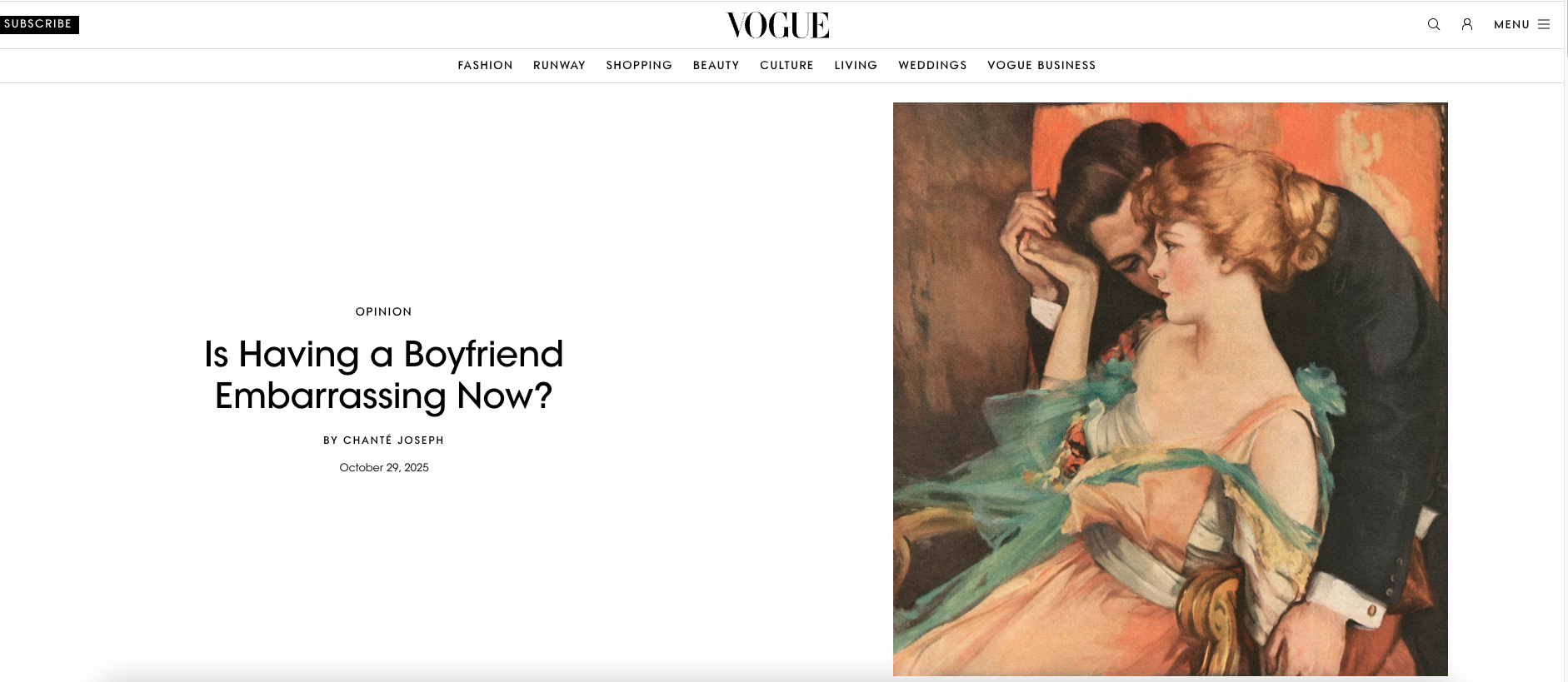
Did you read Vogue’s viral op-ed, “Is Having a Boyfriend Embarrassing Now?” — the one that split the internet and quietly humiliated the #relationshipgoals aesthetic overnight? I did. Then I made the mistake of bringing it up to my girlfriends. Within seconds, I was labeled “negative Nancy,” too cynical, too single to understand.
Maybe that’s exactly why it struck a nerve. Because deep down, we all know what the piece exposed — we’re still obsessed with love, we just don’t want to look like we are.
The irony? Half the women calling me “negative” haven’t posted their boyfriends in years. The other half post them like trophies: look at me, I got the job and the man. What I don’t see is joy — I see PR.
The Shift Nobody Wants to Admit
For years, having a boyfriend was the social equivalent of a blue checkmark — proof of desirability, stability, success. Now, it’s practically a reverse trend.
Writer Chanté Joseph nails it: “Women want the prize and celebration of partnership, but understand the norminess of it.” That sentence alone sums up an entire cultural mood — the quiet cringe that comes with heterosexual performance. We don’t dislike love itself; we just dislike what it’s turned into: a marketing campaign.
The internet made romance a spectacle. Every anniversary became a campaign. Every “candid” couple shot — an ad. And like every overexposed trend, we grew collectively bored.
Performing Love vs. Living It
What’s happening isn’t the death of romance — it’s its rebranding. Women aren’t embarrassed to be in love; they’re embarrassed to appear dependent on it. The performative girlfriend era has expired.
As Vogue writer Chanté Joseph explains, “being visibly loved by a man was once considered the pinnacle of womanhood.” Today, that same visibility reads like a red flag to the chronically online. In a culture where hyper-independence is the new femininity, even posting your boyfriend’s elbow can feel like regression.
And while plenty of influencers still make their husbands part of their brand, it’s hard to tell where affection ends and strategy begins. When your engagement post doubles as sponsored content, is it still love — or just good reach?
Even Vogue’s own example proves the point: influencer Sophie Milner admitted that when she soft-launched her relationship, followers begged, “Please don’t get a boyfriend!” The same audience that once rooted for love now fears it will ruin the fantasy of self-sufficiency.

Maybe this is our cultural hangover from “Boyfriend Land,” that early-Instagram utopia where a woman’s identity orbited the man she dated. We captioned our worth, curated devotion, and called it empowerment. Now, it reads like an archive of dependence.
Today, the new rebellion is silence. The soft launch, the cropped photo, the ghost-tagged partner — these are the new signals of control. Privacy has become a luxury product — a way to say, I don’t need to prove anything to anyone.
So What Now?
Maybe we’re finally detoxing from performative affection. Maybe love, stripped of its hashtags, is quietly rebelling against the algorithm. Because the real flex now isn’t being adored — it’s being unavailable to the audience.
Love hasn’t lost its relevance — just its audience.
So maybe the ugly truth isn’t that boyfriends are embarrassing. Maybe it’s that we finally stopped performing love for an algorithm that never loved us back.
Not single. Not taken. Just off the grid.