Every year at the end of August, a city rises from the cracked mud of Nevada’s Black Rock Desert and then disappears a week later. The locals call it Black Rock City, and it is built for a festival that defies easy description. Burning Man has been described as a survival experiment, a desert utopia, and an annual pilgrimage. It draws more than 70,000 people from around the world, all of whom arrive not to watch but to be the experience.
This year I joined them – with dust on my eyelashes, blisters on my feet and a big Bulgarian family behind me. Here is my first‑person account of what it took to get there, what we built, and why we keep going back.
Building a city from scratch
Before the fun even begins, Burning Man asks you to read the “survival guide”. This is not your typical festival packing list; it’s a manifesto for radical self‑reliance. As the Burning Man Project explains, the event’s Ten Principles include radical self‑reliance, gifting and leave no trace. Participants are expected to bring everything they need – food, water, shelter, even goggles and dust masks – because commerce is forbidden at Black Rock City.
“One of the core principles of Burning Man is radical self‑reliance – that’s why you always carry a respirator mask, goggles for day and night, a scarf to cover your head, a backpack with a hydration bladder or thermos, a headlamp and solar lights, sunscreen and, yes, even a winter hat and coat“
Preparing for the trip felt like equipping for a lunar mission. The playa, a dry lakebed left behind by ancient Lake Lahontan, isn’t sandy; it’s cracked alkaline mud. When vehicles and people grind it to dust and the wind picks up, the white powder fills the air and corrodes metal. Dust storms come without warning, reducing visibility to nothing. A U.S. Geological Survey note explains that the playa is typically dry during late summer but floods each winter; if the wet‑dry cycle fails, the surface becomes soft and loose, creating even more dust. Organizers warn that the alkaline mud can cause “playa foot,” a chemical burn if you walk barefoot.
My campsite, like most others, was a collaboration: a cluster of recreational vehicles (RVs), tents and art structures anchored against the wind. Getting there was another story. Traffic lines into Black Rock City can stretch for 20 hours; our group sat in the mud for hours as 4×4 vehicles hauled stranded buses out of ruts. When you finally arrive, cell service disappears and you’re surrounded by kilometres of camps, art installations and dust. The gift economy means people hand out espresso, massages, hugs or advice. In return, you give something of yourself – a helping hand, a dance, a slice of Bulgarian culture.
How did Burning man start?
Burning Man didn’t begin in the desert. In 1986, Larry Harvey and his friend Jerry James built an eight‑foot‑tall wooden effigy and burned it on Baker Beach in San Francisco. It was supposed to be a cathartic act after a romantic breakup, but the ritual grew. Authorities shut it down in 1990, so the group moved the bonfire to the Black Rock Desert, where the first “Man” burn on the playa laid the foundation for today’s festival. The event is now run by a non‑profit and is guided by ten principles that include decommodification, communal effort and participation.
Black Rock City’s design reflects these values. The camp is built in a semi‑circular plan resembling a giant clock, with the central open space (the playa) at its core. Streets radiate like clock hands and are named by their clock positions, while the concentric roads have thematic names. This layout gives everyone a clear address and turns the urban plan into a piece of art.
Weathering the storm
Even with careful planning, Mother Nature has the final say. In 2025, participants were greeted by heavy winds and dust storms before the event even began. News reports said that strong winds tore through tents and temporarily halted activities A 8‑ton inflatable thundercloud art installation called “Black Cloud” was destroyed in the storm. By Monday, organizers reopened the gates and airport, but warnings of more storms and rain persisted
This year, winds of up to 100 km/h toppled structures and put tens of thousands of us in danger. Days of rain turned the playa surface into a muddy river. We spent hours pushing buses in the mud, then were transferred to four‑wheel‑drive vehicles to reach the portal. But as soon as you arrive, reality melts away – no signal, no currency, no running water or power. Only caravans and tents, giant art installations and tens of thousands of people free to express themselves however they wish.
Such weather isn’t unusual. The Black Rock Desert sees monsoonal moisture in late summer, and the festival’s timing often overlaps with dust storms, hail and thunderstorms In 2024, downpours turned roads into mud and created gridlock. 2025’s winds simply added another chapter to this saga.
Life in the desert
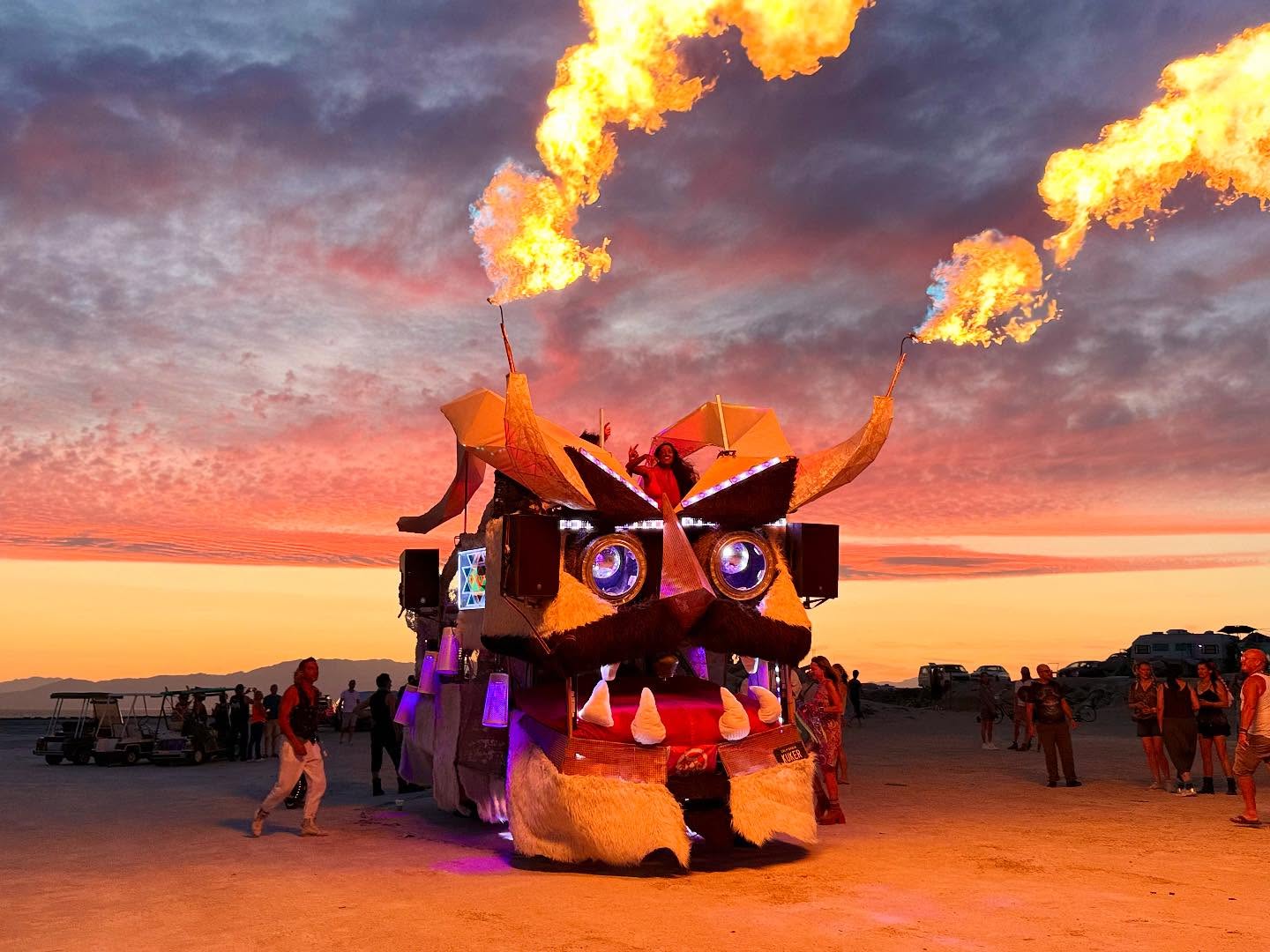
Between the storms, the days and nights in Black Rock City are otherworldly. Mornings begin with sunrise parties, and there’s a constant soundtrack of electronic music, live bands and spontaneous drumming. People ride bikes and mutant vehicles – wildly decorated art cars approved by organizers – across the playa. Some cars resemble dragons or spaceships; our Bulgarian camp’s creation, “Kuker,” is a giant mobile stage that fits 40 people and is covered in lights, digital displays and 20‑kilowatt speakers. Designer Yulian told me that they used washing‑machine drums for the wheels, added disco balls to reflect light and hung cowbells because Bulgarian kukeri (masked dancers) wear bells.
Burning Man celebrates cultural exchange, and this year our camp hosted a traditional Bulgarian dinner – tarator, shopska salad, cured meats and, of course, barbecue. We turned our art car into a roaming dance floor and blasted the folk song “Притури се планината” across the desert. On another night, an acrobatic ballet troupe performed to the same song on one of the festival’s main stages.
Despite the camp’s creative spirit, Burning Man’s relationship with commerce is complicated. The principle of decommodification rejects advertising and sponsorship. However, the festival still needs money to operate, and last year organizers launched a fundraising campaign because there are no brands or sponsors. Critics call this hypocritical, pointing to VIP camps where wealthy attendees network over million‑dollar deals. The paradox is part of Burning Man’s ongoing evolution.
The desert’s extremes also breed unexpected events. This year, authorities launched a murder investigation after a Russian attendee, Vadim Kruglov, was found dead in a pool of blood during the Man burn. It was a chilling reminder that even utopias aren’t immune to violence. On a more hopeful note, a woman who didn’t know she was pregnant gave birth with help from the festival’s medical team.
Leaving no trace, taking only memories
As the week draws to a close, the Man – the towering wooden effigy at the city’s center – is set on fire. The burn serves as a collective release and a reminder that nothing here is permanent. After the fire, the second main structure, the Temple, is burned as well; people leave messages, photos and objects to be consumed by the flame. The next morning, everyone starts cleaning.
Burners take the leave no trace principle seriously. The playa must be as clean as it was when we arrived. Camps dismantle their structures and line up for the long exit drive, again waiting hours to leave. Participants carry trash bags and pick up other people’s debris. It’s exhausting, but there’s pride in returning the desert to its natural state.
Everything you receive here is a gift from someone. Each camp offers something – food, drink, saunas, pedicures, music, art, seminars, yoga, fitness classes, erotic experiences or spiritual workshops. I will leave with the happiness of new friendships, afternoon espressos in the middle of the desert and the warm embrace of a large Kuker family.
Why we keep going back
For many Burners, including our Bulgarian group, Burning Man isn’t a festival – it’s family. Petro Dushkov, one of the camp founders, told me that he went to Burning Man during a difficult period in his life and that the experience “saved my life” by helping him let go of materialism and see his problems from above. He and others are now planning a regional “Balkan Burn” in Bulgaria. Maria Bobeva, another camp member, laughed as she recalled how we were trapped in the mud during last year’s rain and then spent days chipping dried mud from our rugs because you can’t leave anything behind. In the camp’s tenth year, we’re still dancing – in the rain, in the dust storms, through the big storms.
Burning Man grew out of a broken heart on a San Francisco beach, but I found my own heart in the desert.
As I pack my last bag and look at my dust‑covered boots, I realize that Burning Man isn’t just something you do. It’s something you become.